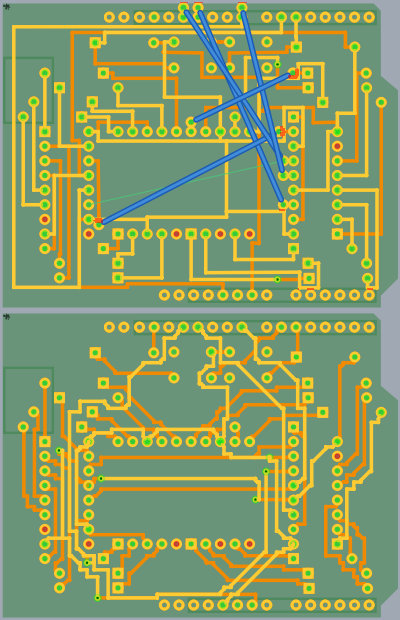
2013 rings in a new Fritzing autorouter. Here are the before-and-after pictures:
The upper image is the Timer example using the old autorouter (version 0.7.10) followed by a Design Rules Check (DRC). The lower image is the same example using the new autorouter (version 0.7.11) again followed by a DRC. The old autorouter was unable to fully route the board, and the DRC found overlaps around the jumpers the autorouter placed. The new autorouter completely routed the board and the DRC found no overlaps.
For the cognoscenti out there, the new version is an A* maze router with rip-up-and-reroute. In practice (and compared with the old autorouter) this means:
- The new router does not have trouble with diagonals.
- The new router does not limit the search in the same way as the old router, so it finds routes that the old router missed.
- After running the new autorouter, the DRC will usually not complain--or at least will only complain a little.
- In schematic view, traces from different nets no longer overlap lengthwise (well, much less frequently than before).
- In schematic view, if a connection can't be routed directly, the autorouter will try to place net labels.
- No more red dots (unconnected zero-length traces)
- Routing is not optimal--there are lots of unnecessary zig-zags--so you will want to do some manual rerouting after the autorouter finishes. We'll be working on this going forward.
- The new router is much slower than the old one (can't win 'em all...).
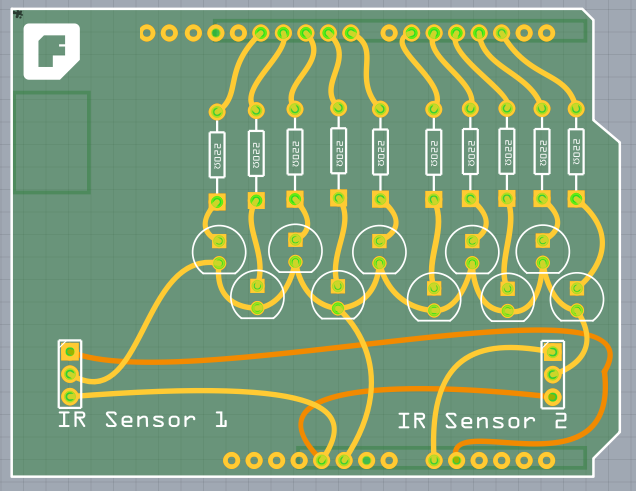
As an extra holiday bonus–and because the DRC and autorouter no longer depend on straight lines–curvy wires are now enabled in PCB and schematic view. Here is a hand-routed example (at least for now, the autorouter can only use straight lines):
Happy 2013,
– Your Fritzing Team.
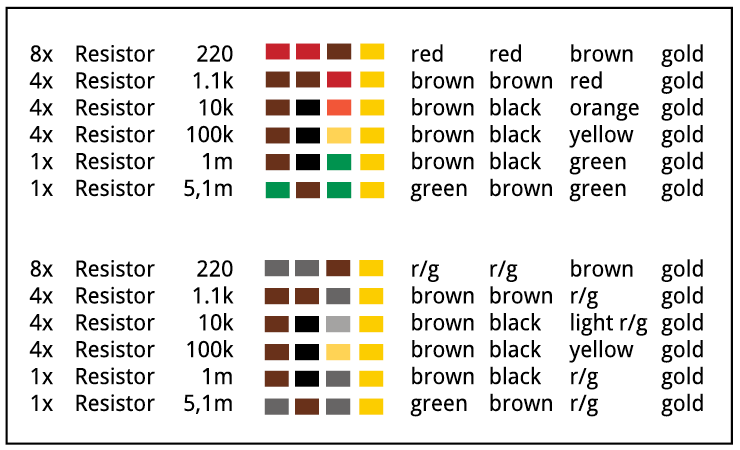
Just a little hint for the people with Dyschromatopsie (thanks to André) :)
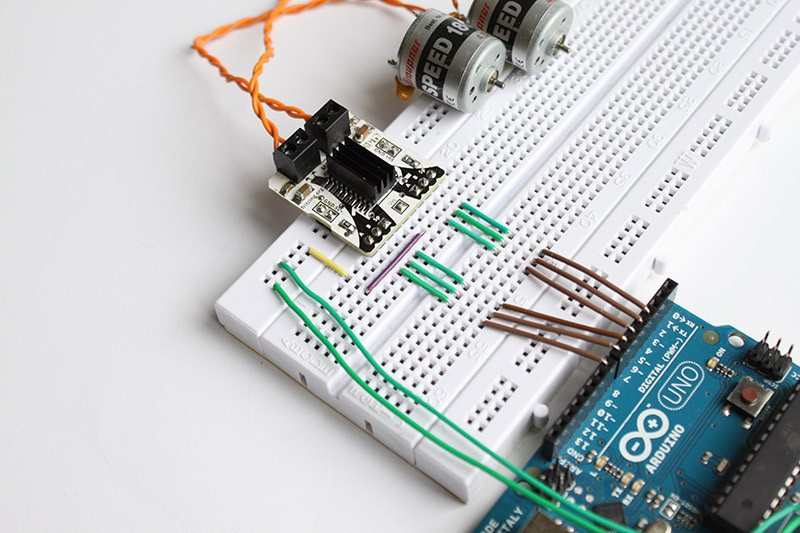 We’re very excited to announce that the Edgy Motor Control is now in store and ready to ship. We’ve been working on this first Edgy for quite some time now (actually Stefan was), and we believe it will further simplify the prototyping phase of projects that require controlling DC motors or a stepper motor.
This breakout board was designed to perfectly fit on a breadboard and reduce cabling to a strict minimum. Adding motors to your project can be considered as an additional block module and no longer an engineering nightmare. We also took care of posting example projects and the necessary code to be used with Arduino to control a stepper motor or two DC motors on our projects page.
The Edgy Motor Control comes assembled and ready to be used out of the box, you can read more details about it on the product page on our shop and place your orders immediately.
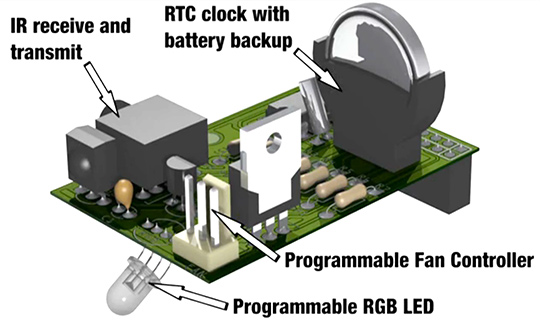
We all love the Raspberry Pi but some things are missing. A real time clock for example. Fritzing user Karl Lattimer just started a Kickstarter to add some cool functionality – the HotPi.
Karl is using Fritzing to document his project and our Fritzing Fab service to prototype the PCB.
The small sized PCB (56x35.4mm) is designed to sit on top of the GPIO (General Purpose Input/Output) port and provides:
– infrared receiving and transmitting
– an RGB LED to lit up in every color
– fan speed control to cool the Pi down
– the real time clock
The Kit is suited with THT (through hole technology) parts, the PCB and will be shipped as a kit.
And of course it will come with an example program to demonstrate the use and functionality, too.
To support the project go to Kickstarter: https://www.kickstarter.com/projects/582604098/hotpi :)
Wir lieben den Raspbery Pi, aber ein paar Dinge vermissen wir schmerzlich. Eine echte Uhr z.B., die auch weiter tickt, wenn der Strom weg ist. Fritzing Benutzer Karl Lattimer hat gerade einen Kickstarter gestartet um den Pi um ein paar coole Features zu erweitern: HotPi.
Karl benutzt Fritzing um sein Projekt zu dokumentieren und unseren Fritzing Fab Service um Prototypen seiner Leiterplatte herzustellen.
Die kleine Platine (56x35.4mm) passt auf den GPIO (General Purpose Input/Output) Port und bietet:
– Infrarot Sende- und Empfangsmodul
– eine RGB LED
– Lüfteranschluss mit Geschwindigkeitskontrolle
– eine Echtzeit-Uhr
Das Kit zum selber löten besteht aus einfach zu montierenden THT (through hole technology) Komponenten und der Platine.
Natürlich gibt es auch ein passendes Programm zum Testen der Funktionen.
Das Projekt kann man auf Kickstarter unterstützen: https://www.kickstarter.com/projects/582604098/hotpi :)
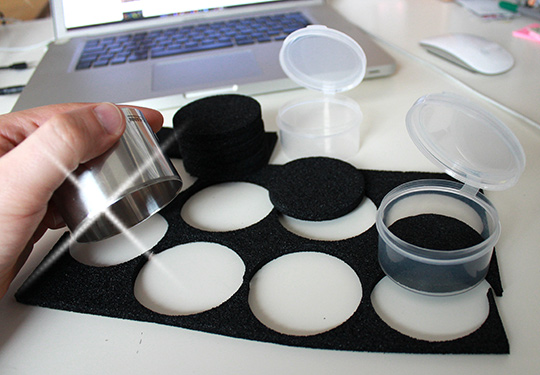
En: We want to support you with the most beautiful products around Physical Computing but that is – of course – not enough – you eat with your eyes first! But we had the problem of how to get round circles out of our black component foam? Since our housekeeping robot stopped to drink he is very bad in cutting with scissors. The weekend shopping tour solved the problem: a fine biscuit cutter looked perfectly suited for the job. Some grinding work later and our first DIY component foam cutter was invented and is now cutting the perfect bed for our soon released Mini-Kits and EDGYs. (But pssst. It is still secret!)
De: Da wollen wir Euch im den schönsten Produkten rund um das Physical Computing versorgen, doch das allein ist uns natürlich nicht genug – das Auge isst schließlich mit! Doch wir standen vor dem Problem, wie wir den eckigen schwarzen Steckschaum in unsere runden Behälter bekommen sollten. Seit dem unser Hausarbeits-Roboter nicht mehr trinke, zittern ihm leider die Hände zu stark, als dass er gut mit der Schere umgehen könnte. Der Wocheneinkauf brachte die Lösung: eine feine Küchen-Stapelform – den »Perfekte Dinner« Fans sicherlich gut bekannt – drängte sich förmlich auf. Etwas Schleifarbeit später und unsere erste DIY-Steckschaum-Ausstechform war geboren und bereitet das perfekte Lager für unsere demnächst erscheinenden Mini-Kits und EDGYs. (Das ist aber noch geheim!)